May 19th, 2025
Workplace safety is a serious concern across industries like construction, manufacturing, oil & gas, and healthcare. Even with strict safety guidelines, many accidents still happen due to a lack of proper training or human error. Traditional safety training methods—such as classroom lectures or printed manuals—often fail to engage employees effectively. This is where 3D safety training animations come in.
These animations make safety training more interactive, engaging, and memorable, helping companies reduce the number of workplace accidents. In this blog, we’ll explore how 3D animation helps in safety training, its benefits, and why it is the future of workplace safety.
3D safety training animation is a computer-generated visual method to teach employees about safety protocols and risk prevention in a realistic, animated environment. It visually simulates real-world scenarios using animated characters, objects, and environments to demonstrate potential risks and how to avoid them.
It combines visual storytelling with technical accuracy, making it ideal for industries where traditional training isn’t enough.
Many companies still rely on classroom lectures, printed manuals, or long PowerPoint presentations for safety training. However, these methods face several problems:
Low Engagement: People often lose focus during long lectures.
Poor Retention: It’s hard to remember everything from text or slides.
Lack of Realism: These methods can’t replicate real danger scenarios.
No Interaction: Employees just listen or read; there’s little participation.
As a result, workers may forget safety protocols or make critical mistakes during emergencies. This is where 3D training animations change the game.
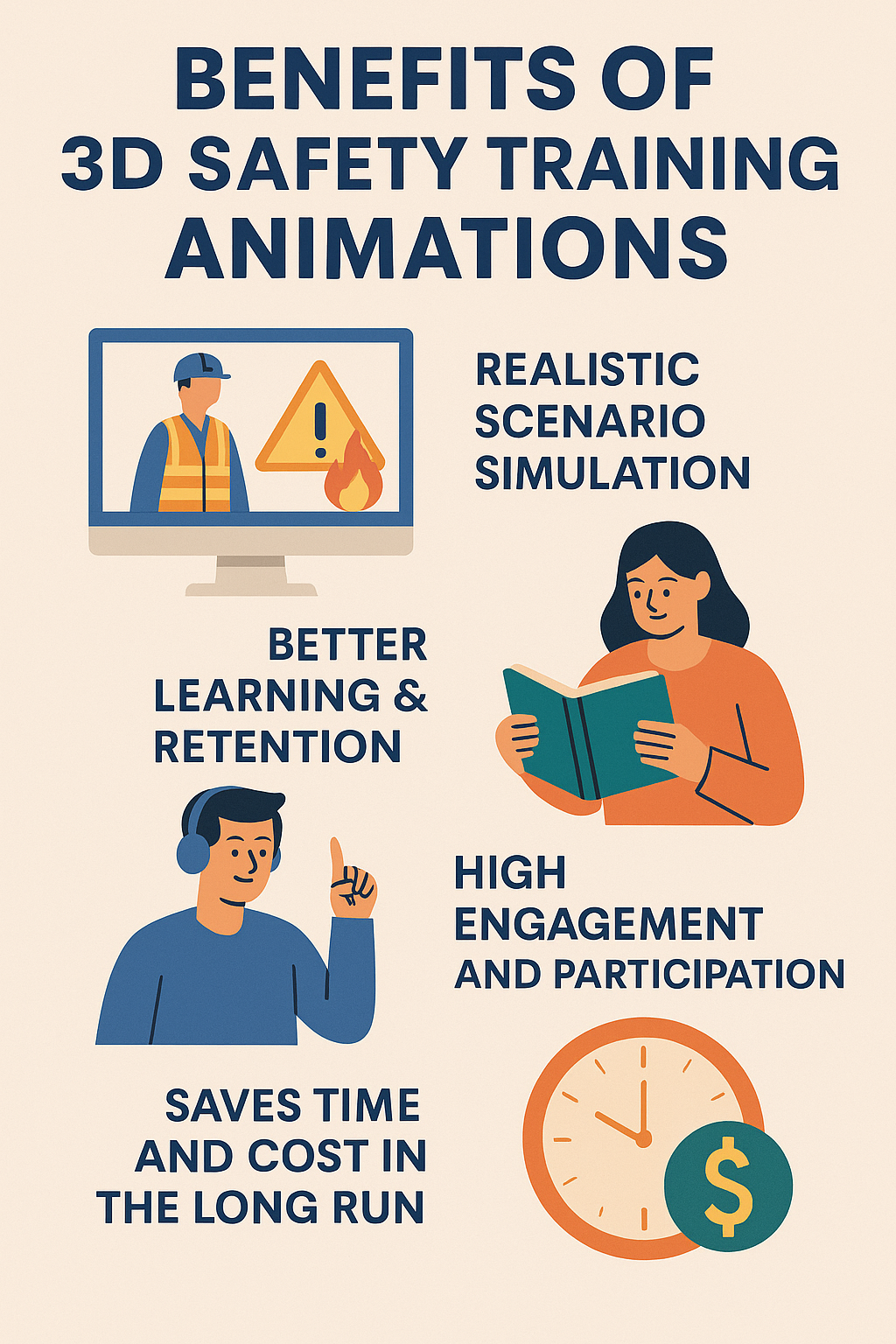
3D animations can recreate real-life workplace hazards in a completely safe, virtual environment. Whether it’s a fire breakout, a fall from a height, or equipment malfunction, these visuals help employees experience the scenario without any actual risk.
This realism increases awareness and prepares them to handle such situations calmly and correctly.
People tend to remember most of what they watch and practice, while they forget a lot of what they only read. 3D animated training appeals to both visual and experiential learning styles, leading to better memory retention.
With repeated viewing, employees reinforce safety rules naturally and effectively.
Animated training is fun to watch and holds attention better than manuals or classroom teaching. It encourages workers to participate actively, ask questions, and even engage in quizzes or decision-making simulations.
An engaged employee is a safer employee.
Although 3D animation development requires an upfront investment, it saves money over time. You don’t need to conduct live training sessions repeatedly or shut down production lines. Employees can be trained online, anytime.
Plus, you avoid potential costs related to workplace injuries, insurance claims, and equipment damage.
In multi-lingual or less-educated workforces, 3D animations overcome language barriers. They visually explain complex procedures without needing advanced reading or writing skills. You can even add voice-overs or subtitles in regional languages.
This makes training more inclusive and accessible.
For companies with multiple sites or locations, 3D animation ensures consistent safety training everywhere. Every employee receives the same quality of training, regardless of geography.
This helps in meeting global safety standards and reducing workplace risks.
Construction is one of the riskiest industries because workers often deal with heights, big machines, and hazardous materials. 3D animations help workers understand risk zones, wear proper gear, and follow safety procedures without confusion.
Machinery accidents, chemical exposure, and electrical hazards are common in factories. Animated videos can explain machine operation safety, lockout/tagout procedures, and emergency exits more clearly than manuals.
Explosions, leaks, and equipment failures are serious risks. 3D animations train workers on how to handle emergencies, evacuate, or use fire safety equipment in high-risk areas.
3D animations help healthcare workers learn infection control, equipment sterilization, emergency patient handling, and hazardous waste disposal more efficiently.
Lifting injuries, forklift accidents, and slip/fall hazards are common in warehouses. Training with visuals helps workers learn how to lift things safely, move around carefully, and stack items properly.
Let’s take a real-life inspired case: A global e-commerce company introduced a 3D animated training module for forklift safety in its warehouses. The animation showed various incorrect and correct ways to operate forklifts, handle loads, and drive in narrow aisles.
Within 6 months of implementing this training, forklift-related incidents dropped by 40%. Workers reported feeling more confident and better informed.
This success story shows how 3D animations can truly reduce accidents and improve safety.
To make the most impact, a 3D animation should include:
Realistic 3D models of the workplace
Clear, step-by-step procedures
Voiceover in the local language
Emergency simulations like fire, leaks, or equipment failure
Interactive decision-making scenarios
Mobile-friendly and easy to access
When done well, these animations act as virtual safety drills, preparing employees for real-world challenges.
Using 3D safety animations not only improves safety but also enhances your brand image and SEO visibility:
You can publish animated training videos on your website and YouTube.
Boosts user engagement and average time on site.
Improves rankings on safety-related keywords.
Builds trust with clients and employees alike.
This makes 3D animation not just a safety tool but also a marketing and reputation tool.
Technology is rapidly changing how companies train their workforce. With the rise of VR (Virtual Reality), AR (Augmented Reality), and AI-based learning systems, 3D safety training is just the beginning.
As industries become more digitized, investing in visual and interactive training solutions will become standard practice.
Companies that adopt these tools early will enjoy fewer accidents, better employee performance, and higher compliance.
Workplace accidents not only harm employees but also affect productivity, company reputation, and legal compliance. Traditional training methods alone are no longer enough to meet the needs of modern, fast-paced industries.
3D safety training animations offer a powerful, cost-effective, and engaging solution. They simulate real-world risks in a safe environment, improve learning, and most importantly—save lives.
If you want to make your workplace safer, smarter, and more prepared, it’s time to invest in 3D safety training animations.
Workplace safety is a serious concern across industries like construction, manufacturing, oil & gas, and healthcare. Even with strict safety guidelines, many accidents still happen due to a lack of proper training or human error. Traditional safety training methods—such as classroom lectures or printed manuals—often fail to engage employees effectively. This is where 3D safety […]

Fill out the form below and we will send you a quote today…
Copyright © 2025 Interactivv.com. All rights reserved.

